Exploring the Migraine Journal: A Comprehensive Tool for Tracking and Managing Migraines
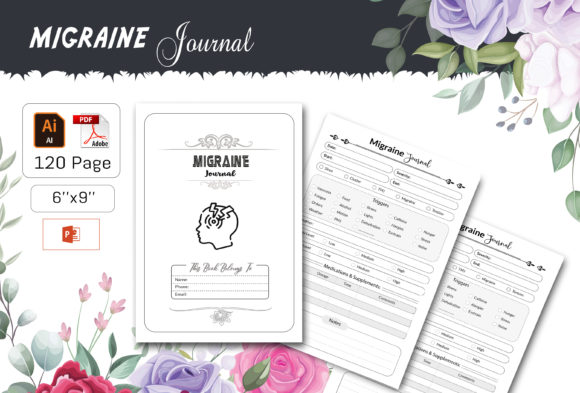
The Migraine Journal is a meticulously designed resource aimed at helping individuals track and manage their migraine symptoms. This journal, available in a 6 x 9 inch format, offers a structured yet flexible approach to documenting and analyzing migraine patterns, triggers, and treatments. Whether you're a long-time sufferer or someone newly diagnosed, the Migraine Journal can be a valuable tool in your journey towards better health.
Key Characteristics and Features
The Migraine Journal comes with several features that make it a standout choice for anyone looking to keep a detailed record of their migraines:
- File Size and Format: The journal is formatted in a 6 x 9 inch size, making it portable and easy to use. It includes a ready-to-upload PDF file, which is print-ready and requires no bleed, ensuring a clean and professional look.
- Editability: The journal is provided in multiple editable formats, including Adobe Illustrator CC 2019 (Ai or EPS), Microsoft PowerPoint 2016 (PPT), and JPEG images. This allows users to customize the journal to fit their specific needs and preferences.
- High-Quality Graphics: All vector shapes are fully editable and resizable, and the journal is printed at a high resolution of 300 dpi, ensuring that all graphics and text are clear and sharp.
- Total Pages: The journal comprises 120 pages, providing ample space for daily, weekly, and monthly tracking over an extended period.
Practical Value and Real-World Use
One of the primary strengths of the Migraine Journal is its practicality. The journal is designed to help users identify and understand their migraine triggers, which can vary widely from person to person. By consistently recording details such as the time of day, dietary habits, stress levels, and environmental factors, users can begin to see patterns and correlations that may not be immediately apparent.
For example, if a user notices that their migraines often occur after consuming certain foods or during periods of high stress, they can take proactive steps to avoid these triggers. This can lead to a significant reduction in the frequency and severity of migraines, improving overall quality of life.
Quality and Usability
The Migraine Journal excels in both quality and usability. The high-resolution graphics and print-ready format ensure that the journal looks professional and is easy to read. The editable files allow for customization, whether it's changing the color scheme to match personal preferences or adding additional sections for more detailed tracking.
Moreover, the journal's 120-page layout is thoughtfully organized, with spaces for daily entries, weekly summaries, and monthly reviews. This structure helps users maintain a consistent and comprehensive record, making it easier to share information with healthcare providers and to make informed decisions about treatment options.
Who Can Benefit from the Migraine Journal?
The Migraine Journal is particularly beneficial for adults aged 20–50 who are actively seeking to manage their migraines. This includes professionals, entrepreneurs, and small business owners who need to maintain productivity and well-being. The journal can also be a valuable tool for educators, freelancers, and serious hobbyists who want to minimize the impact of migraines on their daily activities.
Additionally, the journal can be useful for those who are working with healthcare providers to develop a more effective treatment plan. By providing detailed and accurate data, users can help their doctors make more informed decisions, leading to better outcomes.
Potential Limitations and Considerations
While the Migraine Journal is a robust and versatile tool, it's important to consider a few potential limitations. For instance, the journal requires a level of commitment and consistency in tracking. Users must be willing to document their experiences regularly to gain meaningful insights. Additionally, while the journal provides a structured format, it may not cover every individual's unique needs, and some users may find it necessary to adapt the journal further.
It's also worth noting that the Migraine Journal is a tool for symptom management and should be used in conjunction with medical advice. It is not a substitute for professional healthcare but can be a powerful complement to it.
Conclusion
The Migraine Journal is a well-designed and highly functional tool for anyone looking to better understand and manage their migraines. With its high-quality graphics, editable formats, and thoughtful layout, it offers a practical and effective way to track symptoms, identify triggers, and improve overall well-being. Whether you're a busy professional or a dedicated hobbyist, the Migraine Journal can be a valuable asset in your health management toolkit.